


The combustion chamber test platform of the national major science and technology infrastructure "High-Efficiency and Low-Carbon Gas Turbine Test Facility" has passed the performance and process tests
2026-01-13
From December 4 to 5, 2025, the Bureau of Basic Research and Facilities of the Chinese Academy of Sciences organized an expert panel to conduct a two-day on-site performance and process test on the Combustion Chamber Test Platform in Lianyungang, Jiangsu Province.The platform is part of the National Major Science and Technology Infrastructure—High-Efficiency and Low-Carbon Gas Turbine Test Facility, constructed by the Institute of Engineering Thermophysics, Chinese Academy of Sciences.Xu Gang, Secretary of the Institute’s Party Committee, and relevant personnel from the project headquarters attended the test meeting.
The expert testing panel comprised seven experts from the Chinese Academy of Sciences, Dongfang Steam Turbine Co., Ltd. of Dongfang Electric Corporation, Hangzhou Steam Turbine Power Group Co., Ltd., AECC Shenyang Engine Research Institute, Institute of Mechanics Chinese Academy of Sciences, Tsinghua University, and North China Electric Power University.The panel heard a summary report on the construction of the test platform and reviewed documents including the performance and process test outline, test report, and witness materials.After inquiry, discussion and witnessing the on-site tests, the panel unanimously agreed that the combustion chamber test platform had fully met the acceptance indicators specified in the feasibility study report and preliminary design, and possessed the capability to conduct combustion tests under various temperature and pressure conditions. The performance and process test was approved.
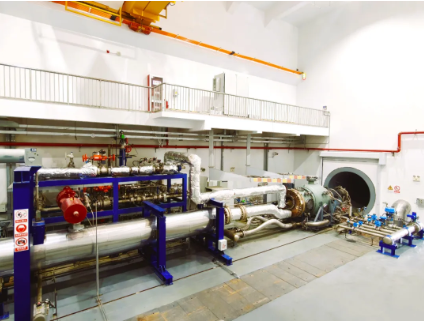
The combustion chamber test platform consists of three test rigs, including a high-temperature and high-pressure optically accessible combustion test rig, a full-temperature pressurized single-can combustor test rig, and a full-temperature full-pressure single-can combustor test rig, with a total of eight test stations.It features high operating parameters, multi-fuel adaptability, multi-working medium compatibility, systematic design, and high-precision measurement. It supports the complete forward R&D process of gas turbines, ranging from fundamental research on combustion theory and the development of key technologies such as fuel nozzles to the development of combustor components.For the first time in China, full-temperature and full-pressure tests have been conducted on full-size single-can combustors for heavy-duty gas turbines using natural gas blended with hydrogen and pure hydrogen. The test support capability has reached an internationally advanced level.
The practice of the "**simultaneous construction, operation and output**" model has laid a solid foundation for the platform’s future open operation and technological breakthroughs. Going forward, the project team will focus on the R&D and technical verification of high-efficiency and low-carbon gas turbine combustors, collaborate with industry, university, research and application partners to tackle key problems, and contribute to China’s independent development of gas turbines and green low-carbon growth.
Visits & Exchanges
- Ingersoll Rand and Garrett Motion Announce Strategic Partnership to Introduce a New Era for Oil‑Free Industrial Innovation
- Zheneng Group Successfully Receives the First Long-term LNG Vessel from bp
- ebm‑papst is presenting the third generation of RadiPac radial fans in a metal housing.
- Doosan Enerbility Wins First Steam Turbine Order for North American Combined Cycle Power Plant
- Baker Hughes has secured a 60-month services agreement with Petrobras to support critical turbomachinery across Brazil’s offshore production system and refining operations.